

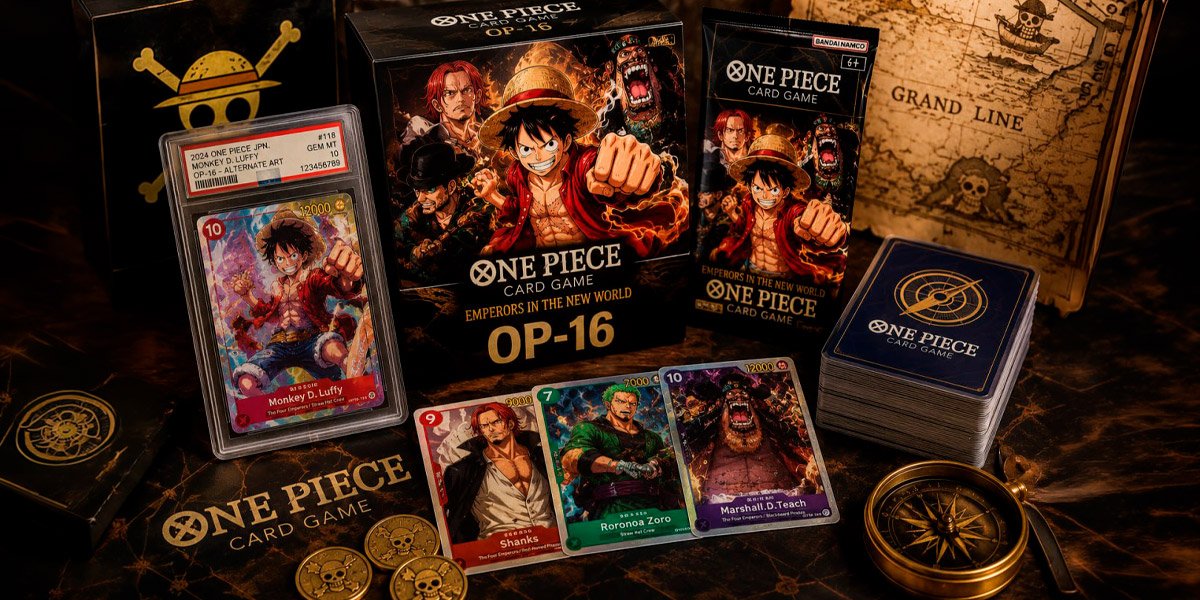
Something quietly significant happened in June. OP-16, One Piece Card Game’s latest main set, launched in Japan and English territories on the exact same day. That’s never happened before. Every set before OP-15 forced English-speaking players — India included — to wait three to six months after Japan got first access.
That gap is gone now. Bandai made the shift official starting with OP-15 back in April, and OP-16 “The Time of Battle” confirmed it wasn’t a one-off. For collectors and players here, that changes the calculus on when to buy and what to expect from availability.
What’s Actually in OP-16
The set returns to the Paramount War arc, one of the most pivotal stretches in the One Piece story, and introduces six new leaders built around the major figures of Marineford — Akainu, Marco, Buggy, and others. Mechanically, it brings in a Jail mechanic tied to Buggy’s leader kit and a Regeneration ability for Marco that’s already reshaping deck-building conversations online.
127 cards total, one Manga Rare Akainu pulling serious secondary market attention, and a meta that’s settled into three real contenders: Purple Enel, Blue-Green Luffy, and a Sengoku-led Three Admirals Navy deck built around character pieces. If you’ve played competitively in past sets, you’ll recognise how fast that tier list can still shift once more players get reps in.
Why the Simultaneous Release Actually Matters
Think about what the old system meant practically. A new set drops in Japan, the competitive scene there starts theorycrafting and refining decks, and by the time English product finally lands, the meta’s already half-figured-out by people who don’t play in your region’s tournaments.
Now everyone starts from the same line. That’s a bigger deal for competitive players than it sounds — no more scrambling to catch up on a meta that’s already three months mature elsewhere.
For collectors, it also means less pressure to import early from Japan just to get ahead of the curve. Collector’s Den carries OP-16 and earlier sets through its One Piece booster box and booster pack categories, sourced and shipped domestically rather than through a slow international pipeline.
Sealed Product or Singles — What’s the Better Call Here?
Depends entirely on why you’re buying.
New players building their first deck are usually better off going straight to One Piece singles — you know your leader, you know which support cards the deck needs, and buying loose packs to chase specific commons is a slow, expensive way to get there.
Collectors chasing the Manga Rare Akainu or any of OP-16’s alternate art leaders are better served by booster boxes, simply because the odds improve across a full box compared to a handful of loose packs. And if display quality matters more than raw odds, graded One Piece slabs skip the hunt entirely — you’re paying for certainty and condition, not chance.
What This Means Going Forward
OP-15 proved the simultaneous release model works. OP-16 confirmed it as the new normal, not a one-time experiment. That’s a real shift for anyone building a One Piece TCG collection in India — the days of waiting out a staggered international rollout are effectively over.
Whatever set comes after OP-16, expect the same day-one access pattern to continue. That’s worth factoring into how far ahead you plan your next pickup, whether it’s chasing a leader for your next deck or just adding to a growing Paramount War collection.
Collector’s Den keeps its One Piece catalogue current with each new drop, so there’s no need to hunt across import sites or wait out a release gap that, as of this year, doesn’t really exist anymore.